
What happens when designers stop drawing and the letters start talking? Chaos, wit, and a wall full of typographic stories.

By the end of the afternoon in PS45, our studio wall looked like a living dictionary. Words turned into images—CLOCK that actually read like time; DISCORD split by the slightest spacing decision; FORBIDDEN reduced to a crisp, legible ban; GATHER compacted into a social mass. Students iterated fast, pinned drafts, argued, refined, and discovered how one clear idea—held steady by typographic discipline—travels further than a dozen clever tricks.
Why Diego, why now?
Thanks to a very serendipitous opportunity provided by Prof. Lígia Lopes, from the MDIP, we had the opportunity to invite Diego Vainesman within the context of the Master’s in Graphic Design and Editorial Projects (MDGPE), articulated with the Ligatures SIG. He has brought a combination of skills and knowledge we value at FBAUP:
- sharp typographic thinking;
- conceptual rigor,
- and professional tempo.


A designer and educator with long-standing international practice (and past leadership at the Type Directors Club), Diego’s workshops simulate real studio pressure: limited time, tight constraints, public critique, and visible outcomes. For the MDGPE —and for some of our bachelor students who joined by voluntary registration— this mode aligns with our goals: thinking with type, communicating ideas clearly and quickly, and learning to articulate decisions under real deadlines.

Opening Talk
“Dorothy y el Jardinero”: Lateral Thinking for Typographic Ideas
Diego Vainesman’s talk set a playful, fast-thinking mood before the workshop: a tour through ambigrams, conceptual typography, and the discipline behind “impossible” images. With humor and a teacher’s directness, he linked pop-culture references (from Angels & Demons to Apple’s “1984”) to a designer’s daily reality: turn an idea into a clear, legible form—under pressure.


It seems obvious to notice the core thread — lateral thinking + common sense. Diego framed creativity as the meeting point between an oblique approach and practical judgment:
Solamente dependeremos de nuestro sentido común y del pensamiento lateral para poder lograrlo.
Lateral thinking isn’t abstraction for its own sake; it’s the ability to reframe a problem, pick the one move that carries meaning, and commit to it.
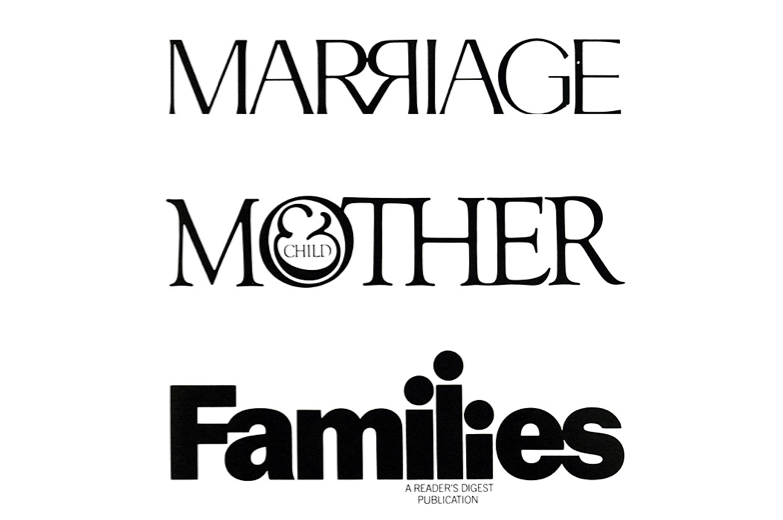
Typographic culture is a toolbox. From the insights learned from decomposing Herb Lubalin‘s (“palabras como imágenes”) masterworks — Mother & Child, or Families logotype** [whose artwork , he explained, was finally decided and instructed to Mike Aron, over a 2 a.m. call from Luballin, to render it as “extend one, shorten the other, and dots on top of all i, and ls”, on the day before the client presentation…]
[ ** just a quick note/update, Diego has just informed me that Lubalin’s assistant was Alan Peckolick, whose work can be immediately related to Lubalin and can be confirmed in the archives of the Lubalin 100 exhibition, “day 58”: Mother & Child & Son & Madonna… but the whole website / archive of the exhibition is well-worth dissecting]
The final design for the Families logotype was decided by a single phone call from Herb Lubalin to designer Mike Aron, who was panicking as the deadline approached. In his characteristic gruff style, Lubalin simply said, “Dot the ‘L’,” which transformed the letter ‘L’ into a stylized representation of a family and secured the classic logo.
https://uniteditions.com/blogs/news/ten-things-you-should-know-about-herb-lubalin
- The panic: As the deadline for the Families magazine logotype approached, Mike Aron, a designer in Lubalin’s studio, began to panic because the design wasn’t working.
- The phone call: Lubalin called Aron and, in his typically abrupt manner, instructed him to “Dot the ‘L'”.
- The solution: This simple instruction led to the creation of the final logo, where the dot of the ‘i’ was used to form a graphic representation of a family unit within the ‘L’ of “Families”.
… to Escher (“si quieres expresar lo imposible, apégate a ciertas reglas”), Diego argued that memorable solutions pair a conceptual spark with rules that protect readability. Variable data, context, and constraints didn’t appear as gimmicks but as design levers— when he also explained/presented the Typographics 35 identity/cover designed by Brian Collins / Collins Studio — ways to embed information, pace reading, and stage a reveal.


Ambigrams, context, and the ‘aha’ moment. Using the overnight rise of ambigrams after The Da Vinci Code as a case in point, he showed how cultural context can unlock comprehension at scale. Yet the lesson stayed practical: “La innovación… no significa dejar de usar lo anterior… pensar en algo nuevo es pensar diferente”—and make it readable.
In short, Diego’s conference made a simple promise that the afternoon studio kept: use type to think. Pick the right constraint, make the idea visible, and let the form [and if possible the data] tell the story—clearly, quickly, and with just enough wit to stick.
Calligram Workshop — Turning Words into Images with Type


Diego’s candid classroom story landed the most actionable advice of the day: learn to critique and to be critiqued. The goal isn’t politeness; it’s clarity.
Digan la verdad… estás ayudando a la otra persona.
That habit trains the arguments you’ll need when it’s 2 a.m. and the client review is at nine.

Immediately after the conference, Room PS45 turned into a fast-paced typographic lab. The assignment was deceptively simple: choose three words from assigned dictionary pages and transform each into a calligram —a visual composition where typography becomes image. No color, no gradients, no effects— just black and white, sans serif, and clarity of thought.
You only need one idea — visible, smart, and readable.”
That was Diego Vainesman’s mantra as students printed and pinned their first attempts on the wall.
The Wall of Words
The first part of the session unfolded as a collective critique. Each group presented their printed drafts—clock, collapse, junk, discord, deity, and more—while Diego, pacing between the rows, dissected their logic and legibility.
He asked the room to see what the words were doing:
If the word is collapsing, make it fall… don’t tell me—show me.”
This phase made visible how meaning travels through form. A single misplaced curve or extra stroke could break the story. Diego insisted on constraint as discipline—keep the experiment within boundaries so that one change becomes significant. Students learned to adjust only what mattered: a letter’s tilt, its proximity, or rhythm—never (or avoiding) everything at once.


Critique quickly became conversation. Students analyzed one another’s work, debating reading direction, balance, and the anatomy of each move.
Criticizing others’ work trains your own eye. At two in the morning, it’s you who has to decide what works.”
Editing in a fast-paced motion
After the wall critique, everyone returned to their computers for a second round. Diego moved from desk to desk like a newsroom editor—short feedback, quick corrections, precise suggestions.


“Don’t change all the parameters at once,” he reminded one group. “If you vary caps, size, and weight simultaneously, you lose the idea. Decide what tells the story—one or two variables, not five.”
Here the workshop shifted from concept to craft: students refined spacing, adjusted direction, explored rhythm and hierarchy. The constraint of black-and-white design forced precision—contrast, not ornament, became the language.


In the final hour, students designed (and exported PDFs) of the new iterations. Each calligram revealed a distilled story: Clock reduced to rhythm, Gather compressed into proximity, Forbidden locked behind a shape, Karate kicking through a single letter.
The day ended with a collective reflection on storytelling through type—how words can act, not just mean.
If your concept is strong, it doesn’t need decoration. Simplicity is power.”


Main Takeaways from the Workshop
Raise execution to meet the idea. “Many times your concept is here (raised hand) and your execution is here (lowered hand)—raise it.”
1. One concept, one gesture, one visible move.
A calligram works when form and meaning converge in a single, readable idea. Multiplying effects only dilutes the message. If everything changes, nothing (or everything will be more difficult to) read.
2. Choose and maintain constraints.
Vary one or two visual parameters—scale, font size, font weight, upper and/or lowercase, alternate glyphs, direction, spacing, or weight—and keep the rest consistent. This discipline reveals what really changes perception. Choose a concept and a set of constraints. Lock them in and change just one (or even two), seldom more.
3. Storytelling through form.
The goal is not illustration, but translation: make the word do what it says. Each typographic move should reinforce the concept’s action, rhythm, or tone. Let counters and negative space work. Meaning often sits around the letter, not just inside it.
4. Respect the reader’s path.
Design for legibility and flow; guide the eye left to right, or through deliberate disruption that feels meaningful, not random. Respect reading direction and rhythm. Guide the eye; don’t fight it.
5. Use critique as rehearsal.
Learning to articulate why a solution works prepares students for professional dialogue—with clients, collaborators, and their own midnight selves.
6. Refine through iteration.
Printing, pinning, and revising creates critical distance—the wall becomes a mirror, revealing what the screen hides.
By the end of the day, the classroom wall resembled a typographic landscape—each word a small story told through form.
In Diego’s hands, the exercise became more than a lettering challenge; it was a lesson in thinking with type, balancing intuition and structure, and keeping design both simple and alive.
Gratitude & Acknowledgements
This session was only possible because of the generous organization and facilitation by Prof. Lígia Lopes, with co-organization of the MDGPE extended training program, within the activities of the Ligatures Special Interest Group (SIG) from the i2ADS. Our warmest and most heartfelt thanks to Diego for a day that was energetic, generous, and concrete—exactly the balance our students need between idea, form, and time.
Transcription of audio and content summarization and textual editing provided by Google Gemini and ChatGPT. Photos edited in Lightroom Mobile