
Last week — during the academic week — we’ve celebrated the IJUP’s 19th edition. The MDGPE student community got represented nad represented almost half of the participants with the 2nd years students and one proud representative of the 1st year also attending! 😉
In the 19th edition of the Young Researchers Meeting of U.Porto (IJUP), which took place from May 6th to 8th, 2026, the academic community once again gathered to celebrate over 1,000 emerging scientific talents. For the Master in Graphic Design and Editorial Projects (MDGPE), this year — despite a lower attendance than usual from our program* — was yet another profound testament to the strength, curiosity, and vibrant culture of our students.
* we have still to achieve 50% attendance of our students at the IJUP… that’s our goal for 2027!
Watching our students step up to the podium or stand by their posters, we often find ourselves pondering a classic academic paradox: Are these students presenting because they are inherently dedicated, or does the brave act of presenting itself fuel their dedication? Seeing the sheer effort, the late nights of preparation, and the enthusiastic peer support, the answer seems to be a beautiful, cyclical mix of both. Whether it’s the pursuit of knowledge that brings them to the stage, or the stage that solidifies their commitment as researchers and designers, their presence is inspiring. The IJUP is not just a showcase; it is a training ground.

A Vibrant Arts & Design Community
The sense of community across the Faculty of Fine Arts (FBAUP) and beyond was palpable. A huge shout-out is owed to Francisco Ribeiro (from the MDI program, supervised by Prof. Heitor), who was part of the organizing committee and captured the fantastic photograph featured above!
The collaborative spirit was everywhere. We were treated to a deeply moving presentation from the PDMD doctoral program by the mother-and-one-year-old-son duo Nara Coló Rosetto titled Out of rhythm – sound, silence, and the stolen time (supervised by Filipa Cruz).
We also witnessed a fantastic breakdown of the Portugalia Magazine in a couple of presentations from the Faculty of Arts and Humanities (FLUP) by Guilherme Santos and Carlota Rodrigues (supervised by Rita Gaspar). Their projects, Photography as illustration in the transition from the 19th to the 20th century. The Portugalia journal and Black and white Artworks for publication. The turn of the century (1899-1908) Portugalia Journal, sparked an incredible debate with the jury and attendees about early 20th-century editorial design, publishing, and the state-of-the-art printing methods of the time — was it engraved because of cientific purposes? or because of printing constraints? This looked like a Sherlock Holmes case… 😉 These are exactly the kinds of cross-disciplinary conversations everyone should attend IJUP to experience!
Other incredibly notable communications from sister institutions included:
Rafaela Schmidt with Comparing frames: When Orpheus looks back. Though a brief analysis, her speculative interpretations were absolutely fantastic—a great lens through which to view contemporary image and film creation.

Rita Isabel Lino Barros (supervised by Rute Ribeiro Rosas ) with Inhabiting Absence: Trust as a Propelling Agent in Sculptural Artistic Research. This was a beautiful, autobiographical presentation explaining the metaphors and growth that arise from overcoming grief and loss.
Oral Communications: The Brave 40%
Coming back to our MDGPE master program students. This year, there were 15 oral communications in the Arts panels. Out of those, 6 were from our very own MDGPE students—making up exactly 40% of the presentations! Delivering an oral communication takes immense courage, and our students shone brightly:

Hugo Carvalho (supervised by Pedro Amado ) presented Computational Simulation Models in Typeface Legibility Research Assessing Reliability as an Alternative to Tests with Visually Impaired Participants. Hugo delivered a really nice, fluid presentation. Though the experimental design was a bit complex for the audience, the data is being crunched as we speak, and this event served as the perfect training ground for the final — and most likely on time — delivery and presentation of his master!

André do Carmo Gonçalves (supervised by Pedro Amado and Vítor Quelhas from the ESMAD / ID+ ) presented The Revival of Tia Lira: Reinterpreting cultural legacy in type design through variable font technology. André gave a highly dynamic, warm, and very well-thought-out delivery. The design and materials were fantastic (though we admit we are a bit biased!).
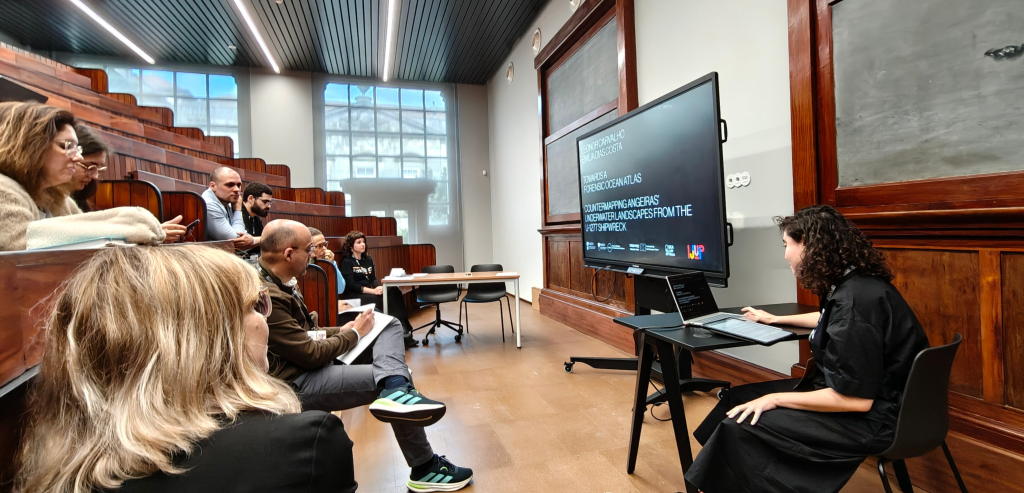
Leonor Carvalho (supervised by Emília Costa ) presented Towards a Forensic Ocean Atlas: Countermapping Angeiras’ Underwater Landscapes from the U-1277 Shipwreck. This sparked a great review of maps and representations, leading to an engaging debate with the jury about the contemporary use of mapping.

Beatriz Oliveira (supervised by Cristina Ferreira ) presented The Body as Emotional Archive or Choreographic Artifact Exploring the Performative Potential of the Book as a Space of Memory and Design.
We also want to acknowledge the hard work of the students whose communications were accepted but who were unable to present on the day:
Ana Maria Guimarães (supervised by Emília Dias Costa ) for Inclusive Design and Learning: An Analysis of Public School Textbooks for Students with Down Syndrome.
Diana Marques Ferreira (supervised by Cristina Ferreira and Hernâni Zão ) for Personal Branding Process Mediated by Information Design: Co-creation of a Toolkit to Assess the Potential Mitigation of Factors Associated with Burnout among Healthcare Professionals.
The Poster Sessions: The MDGPE “majority clan”
The poster sessions remain a highly sought-after format, and this year, MDGPE students completely dominated the Arts categories! Out of a total of 13 posters, 7 were from our Master’s program—an impressive 53.8%.
Huge congratulations to the following MDGPE researchers:
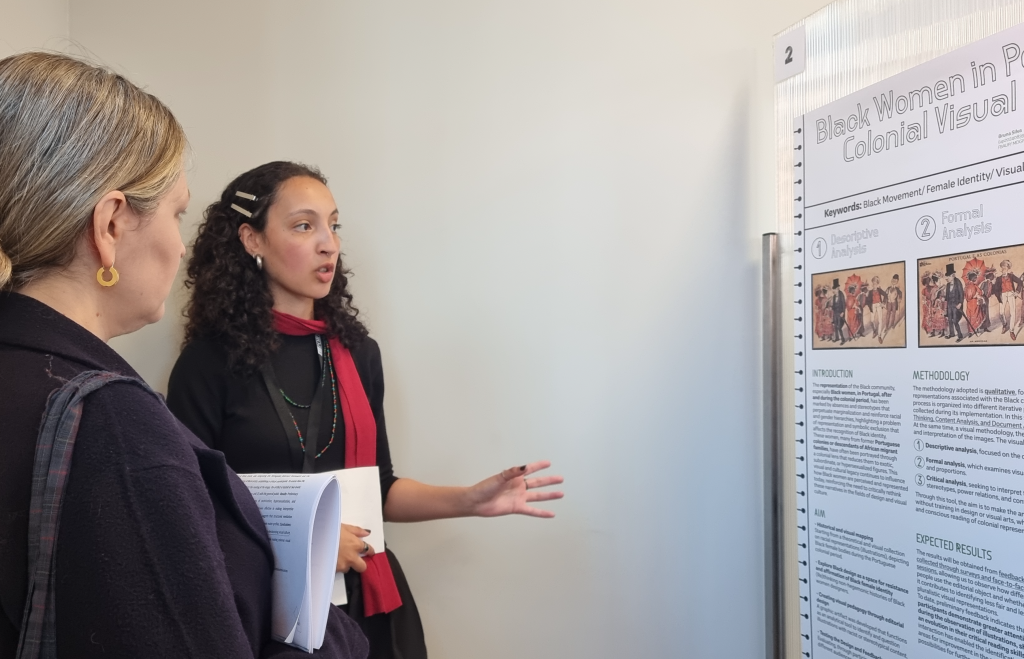
Bruna Silva (supervised by Cristina Ferreira and Margarida Dias ): Black Women in Portuguese Colonial Visual Culture.
Ana Sofia Coelho (supervised by Pedro Amado and Eliana Penedos-Santiago ): Dimensional Typography: Variable Font for Extended Reality Interfaces Supporting Social Reconnection of Users with Physical Limitations.
Maria Luísa Pinto (supervised by Cristina Ferreira ): Editorial Practice as Reactivation: From Archival Digitisation to Editorial Mediation in the Desmond Morris Archive at MHNC-UP.
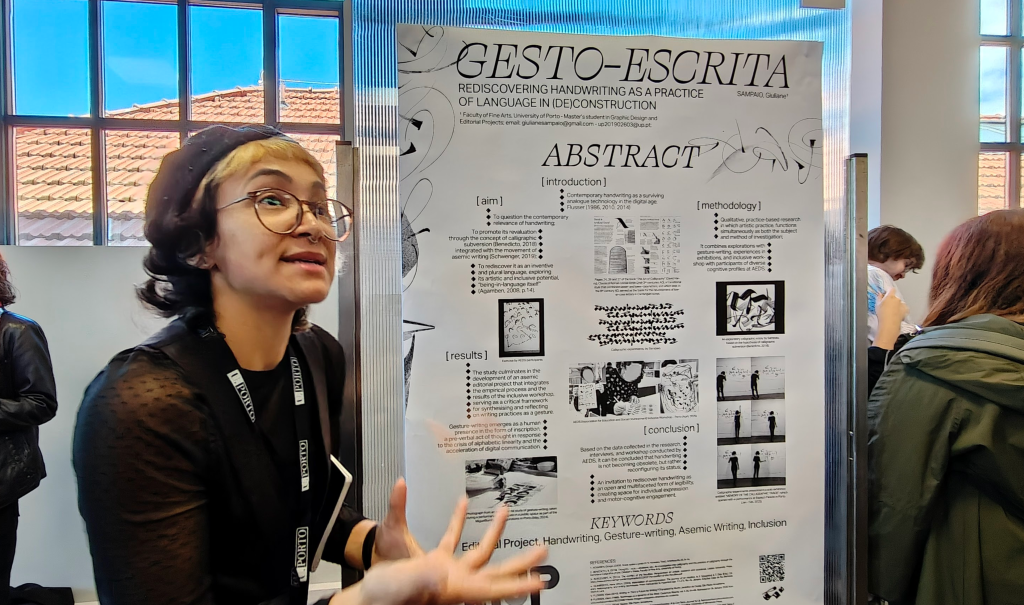
Giuliane Sampaio (supervised by André Rangel): GESTO-ESCRITA: An Asemic Editorial Project from an Artistic and Inclusive Perspective – Rediscovering Handwriting as a Practice of Language in (De)constructio.
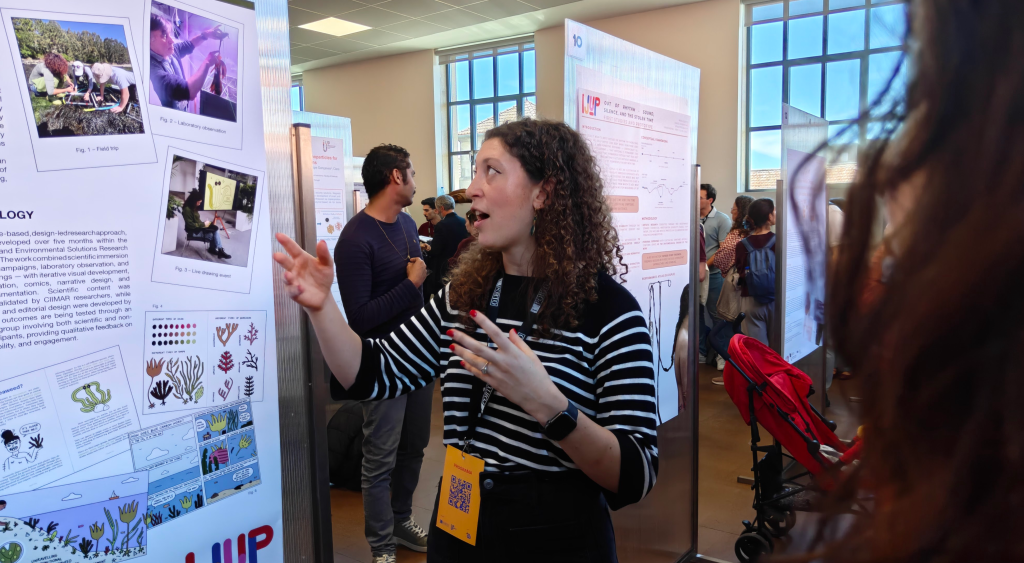
Susanna Morari (supervised by Júlio Dolbeth and Marina Dolbeth ): Internship at CIIMAR: Discovering the marine forest.
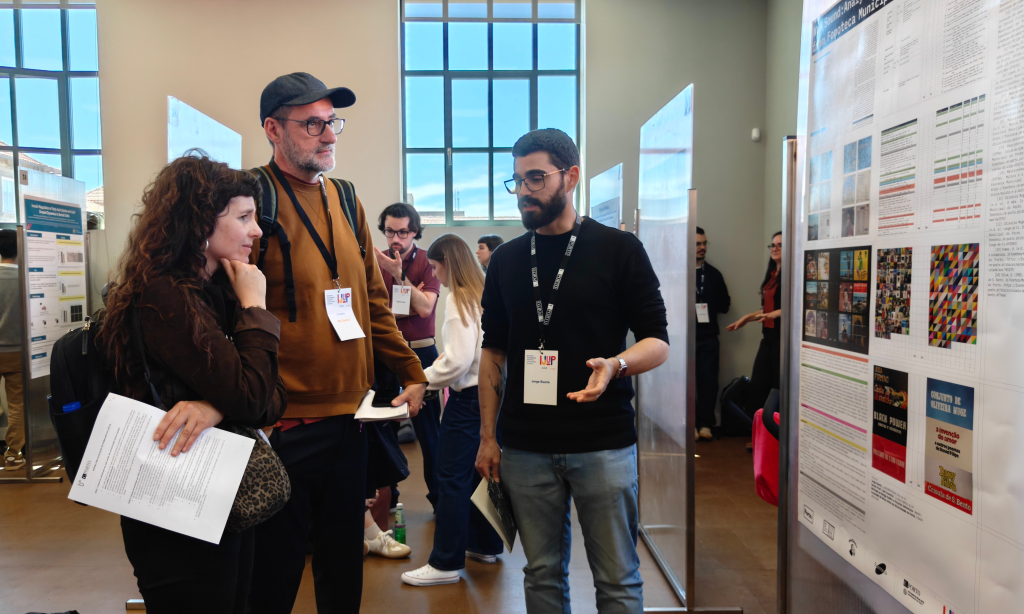
Jorge Duarte (supervised by José Carneiro ): New Sound: Analysis of Luso-African Collection from Fonoteca Municipal do Porto (1960–1992).

Claudia Martina (supervised by Cristina Ferreira ): Queer-feminist Graphic Design: A sapphic zine as a tool of resistance and lesbian identity.
We also want to celebrate the excellent poster presentations from other FBAUP Master’s programs such as the MDI, MIEI and MDIP:
Gavin Portillo (MDIP, supervised by Rui Mendonça and Cláudia Lima ): E-Waste in Product Design: A Designer’s Iterative Process for Recycling Solutions.
Rui Silva (MDIP, supervised by Rui Mendonça and Cláudia Lima ): From Digital to Material: The integration of Additive Manufacturing with Formative Manufacturing.
Camila Cota (MIEI, supervised by Júlio Dolbeth ): Vida de Artista: The independent illustration work in Portugal in the context of self-publishing fairs and author businesses. Her presentation was wonderfully sincere and insightful. And it was a delight to testify her presentation 😉
Although our total numbers may fluctuate year by year, the MDGPE remains one of the single largest contributors to the IJUP. It is vital to remember that our students and faculty are not sponsored or paid to do this; this immense effort is driven purely by the desire to push boundaries, test ideas, and successfully complete rigorous academic training.
To all the students who dedicated their time, nerves, and intellect to this event: whether your dedication brought you to the stage, or the stage forged your dedication, we are incredibly proud of you. Here is to your continued curiosity and the ever-growing strength of this academic community!
Well done, everyone!
Authorship & Transparency Note: This post was drafted with the generative assistance of the AI model Google Gemini Pro 3.1, and was heavily edited, fact-checked, and finalized by the MDGPE director to ensure accuracy and contextual truthfulness. The author’s insights and opinions were taken into account. Any omission or inacuracy may be present — due to human limitations — and we apologize in advance